Family Wishlist / Independent open source
Family gifts.
Minus the guesswork.
A private place for everyone’s gift ideas, from a shop link to a day out together. Family members can add wishes, plan presents, and keep the recipient out of the loop.
Free and open source, running in your own Cloudflare account. Set it up yourself, or ask Furls for a hand.
Why it exists
Gift ideas, without the accidental spoilers.
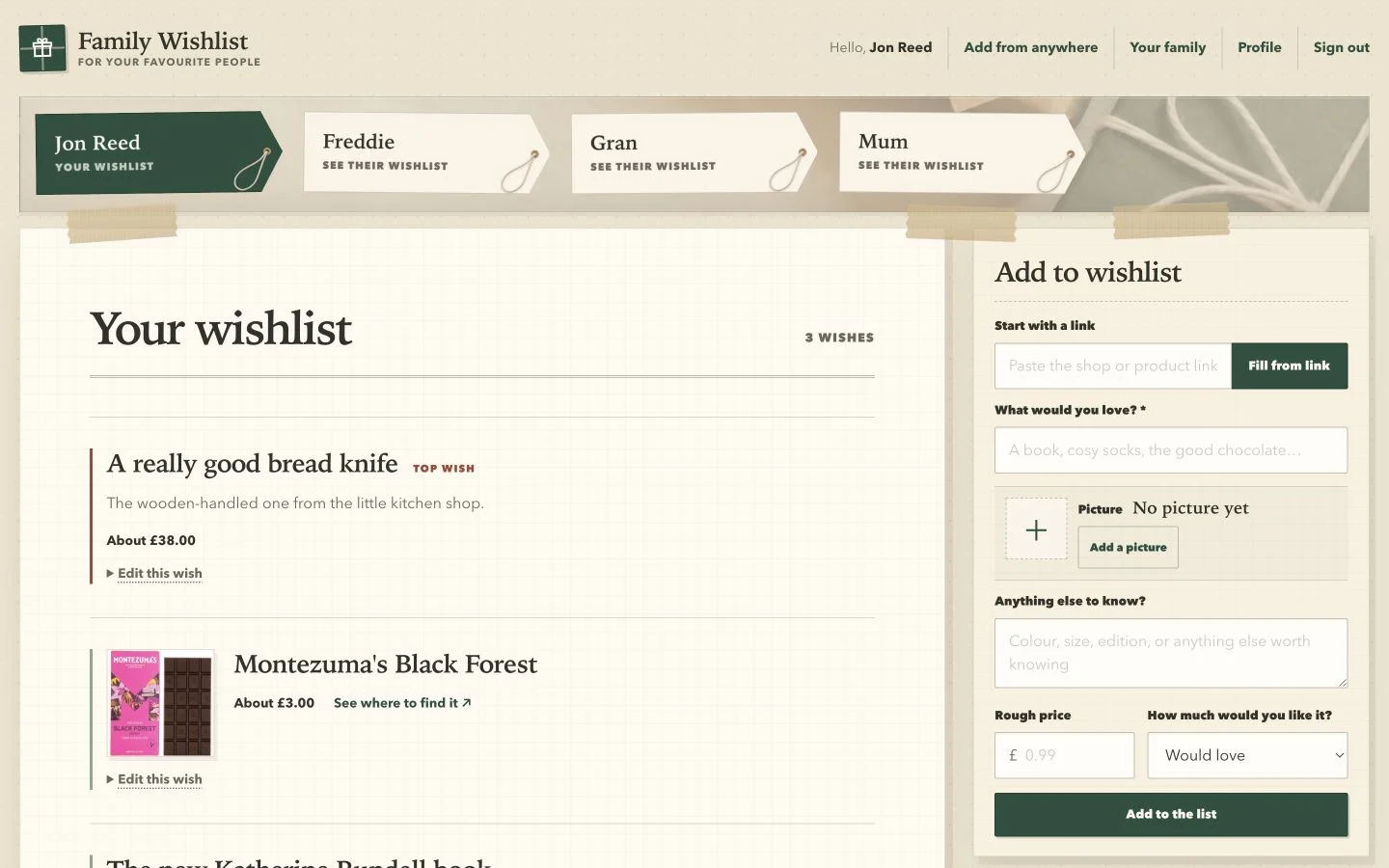
Everyone in an invited family can keep a wishlist and help edit the others. They can also claim a present while its intended owner remains blissfully unaware. That last detail is doing quite a lot of work.
The application is designed around one independent deployment per invited family. Cloudflare Access admits exact email addresses using a one-time PIN, so there is no application password database to run.
Each family controls its own deployment and data. There is no central Furls account holding everyone’s Christmas secrets.
Privacy in the design
The owner cannot peek at their own claims.
The interface is only the visible part. Identity, queries, and types all reinforce the same rule underneath it.
- Admission
- Cloudflare Access checks an exact email allow-list and signs the family member in with a one-time PIN.
- Identity
- The Worker verifies the Access assertion before it trusts an identity or reads family data.
- Owner view
- An owner’s query does not return their claims. The TypeScript owner type has no claim field either.
- One claim
- The item ID is the claim’s primary key in the database, enforcing one active claim for each wish.
- Read-only sharing
- Revocable links expose one wishlist through a separate query that never selects claims.
Adding a wish
Paste a link. Keep the final say.
Paste a product link, or send it from your phone or desktop browser using the app’s sharing tools. Family Wishlist can turn it into an editable draft, starting with details published by the shop and keeping the original link attached.
If an ordinary request finds a blocked or empty page, Cloudflare’s browser rendering gets one carefully limited attempt. Workers AI is restricted to missing fields and checked against reduced page evidence.
It can help with a missing name or price, or choose a likely image from validated candidates. It cannot save the wish. People still decide what goes on the list, which feels only fair.
Quietly resilient
No JavaScript? Still a wishlist.
Core list and claim actions use server-rendered pages and ordinary forms. Enhancements make selected journeys smoother, but the essential job does not depend on them.
Reading, adding, editing, and claiming still work without browser JavaScript. Small self-hosted scripts make selected journeys more convenient.
Private pages use defensive response headers and load no third-party scripts or fonts. Family HTML and data are served with private, no-store caching.
A family member can create a revocable, read-only link for someone outside the private space. Its dedicated data path contains no claim information.
The repository publishes its architecture, tests, and an AI-assisted adversarial source review, including the original findings, fixes, and the review’s stated limits.
Ownership and stewardship
Open source. Family operated.
Cloudflare Family Wishlist is an independent open-source project maintained by Jon Reed. Development tooling was funded by Furls Digital Ltd, with that relationship documented in the repository.
The source is MIT licensed. Each family operates its own deployment and keeps its wishlist data in its chosen Cloudflare account. It is not hosted by Furls.
The Family Wishlist website covers the features, sharing tools, and how to get started. Furls also offers optional paid setup help, with the work and price agreed before anything starts. Ongoing support is agreed separately.
Make it yours
Run it for your family.
Take a look around the product site, follow the self-hosting guide, or get setup help from Furls. Your family’s lists stay in your own Cloudflare account.
familywishlist.org↗